For boutique development consultancies · 5–50 people
The ToR names the roles. We match your experts.
In ten donor evaluation grids we could read in full, the experts you name carried between 30% and 100% of the technical score. So this reads your Terms of Reference role by role and answers the only question that grid asks: which of your own people clears each requirement — and which requirement nobody on your bench closes.
Below is the actual product surface, rebuilt here from its own stylesheet. Click the tabs.
Compliance against 25 requirements
Illustrative screen · real measured figuresEach requirement is read on its own. Where the bench holds no evidence, the row says “no data” — it is never filled in by guessing.
Stop signal
On a different tender the same matrix returned 19%, — below the level where a bid is worth writing, so document generation was blocked instantly and zero API calls were spent. The point of the product is also to stop you.
Role shortlist — Sr. Energy Efficiency Expert
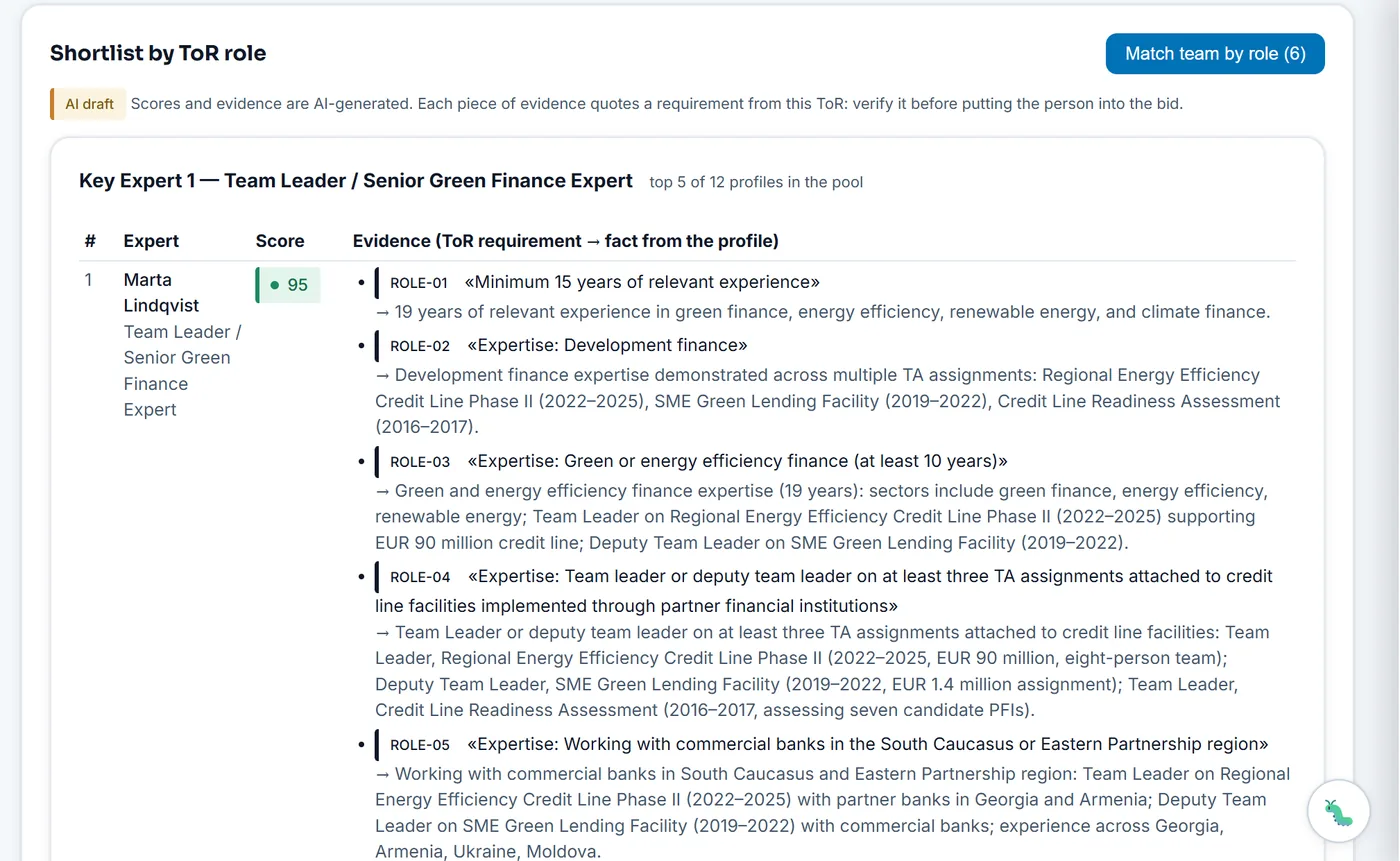
Illustrative namesTop 4 of 100 profiles. Every line of reasoning quotes a numbered requirement from this ToR; below three citations no score is given at all.
| # | Expert | Score | Evidence — ToR requirement → fact from profile |
|---|---|---|---|
| 1 | A. MarchettiSenior Consultant · Energy | 82 |
|
| 2 | K. NowakAssociate · Climate finance | 74 |
|
| 3 | S. HalvorsenSenior Engineer | 58 |
|
| 4 | D. FerreiraConsultant · MRV incomplete profile |
31 |
|
Market slice — CPV 71 · engineering services
Illustrative firm namesMethodology, always on screen: sums are counted on the awarded basis (what was actually contracted), not on notice ceilings — the two differ by multiples. Excluded buckets are listed with every slice, and every export carries the same note.
The one thing that is ours
Press the button and watch the bench get read.
Thirteen competing products were examined. They search a CV library by skill. None of them answers the question the ToR is actually asking — which of our people clears these criteria, and what are we missing.
Your bench goes in once
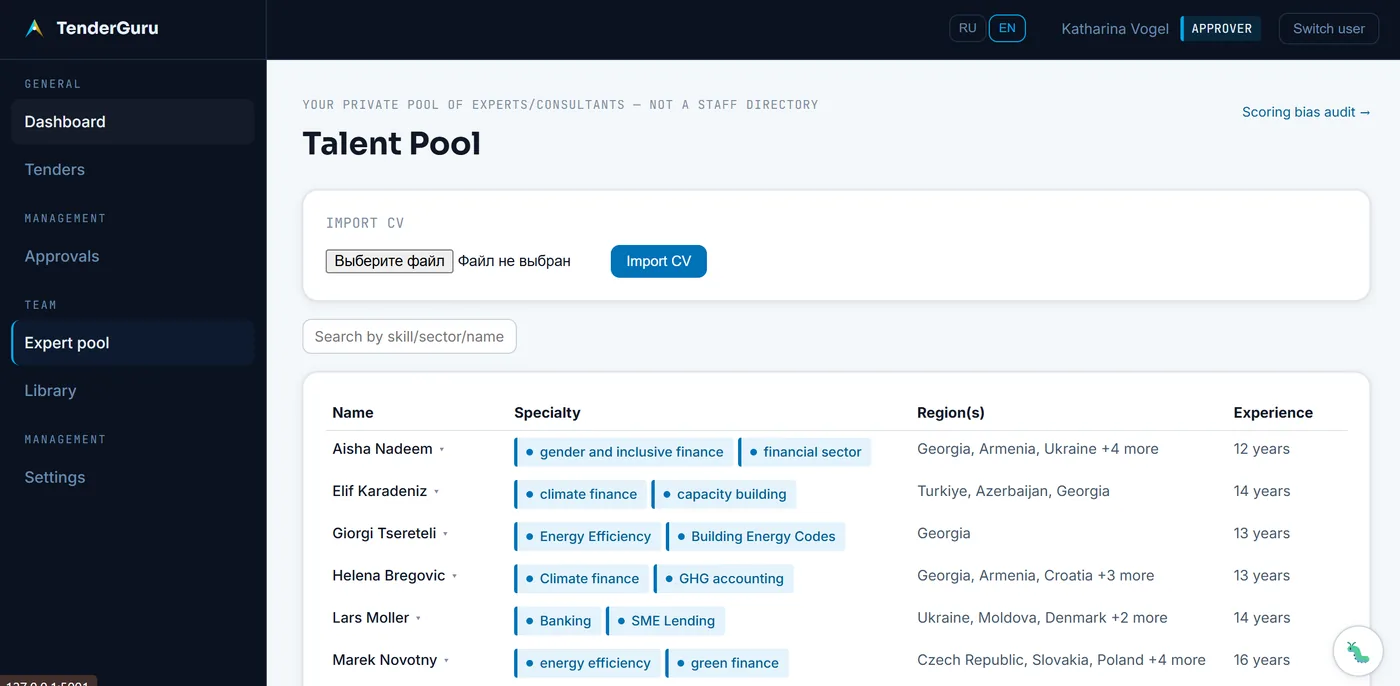
Projects, skills, regions, languages, certificates. It stays yours.
The ToR names the roles
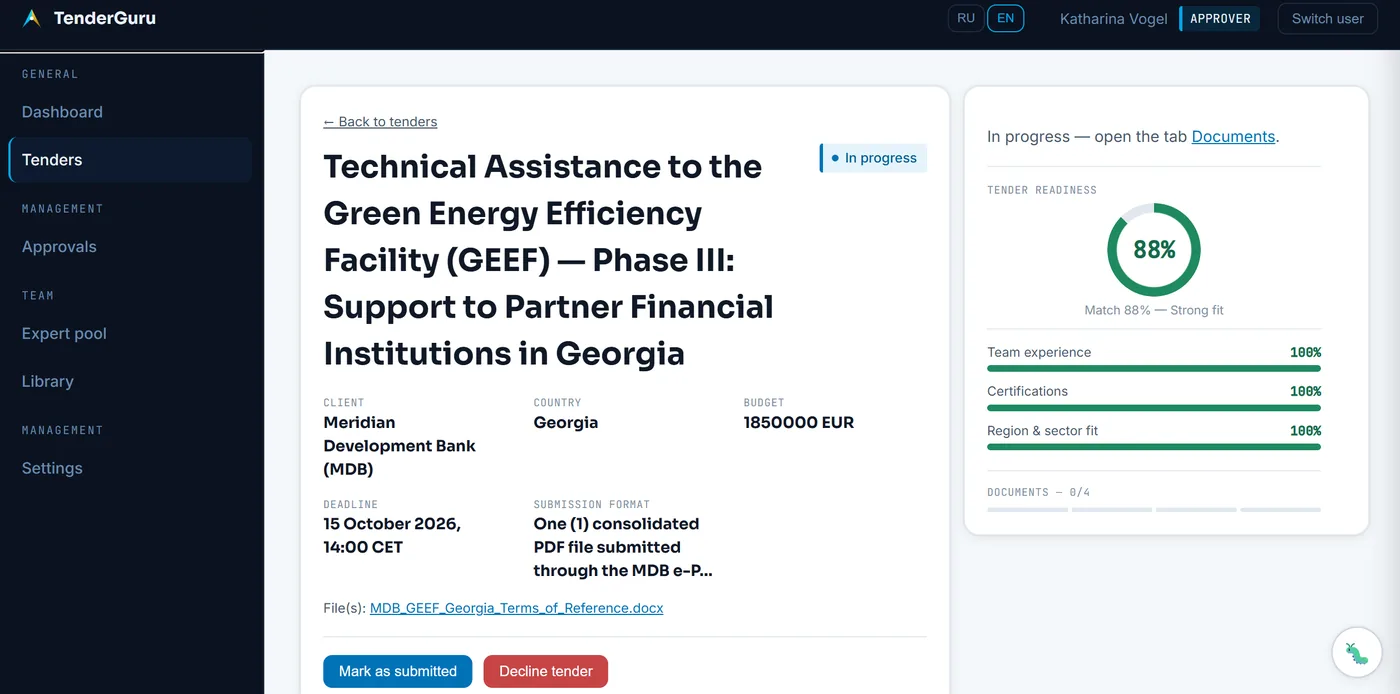
Six roles were read out of this document, each with its own years, degrees and country requirements.
People are ranked per role
Top five per role, each line quoting a numbered requirement. Under three citations the model is not allowed to produce a score.
The gap is named
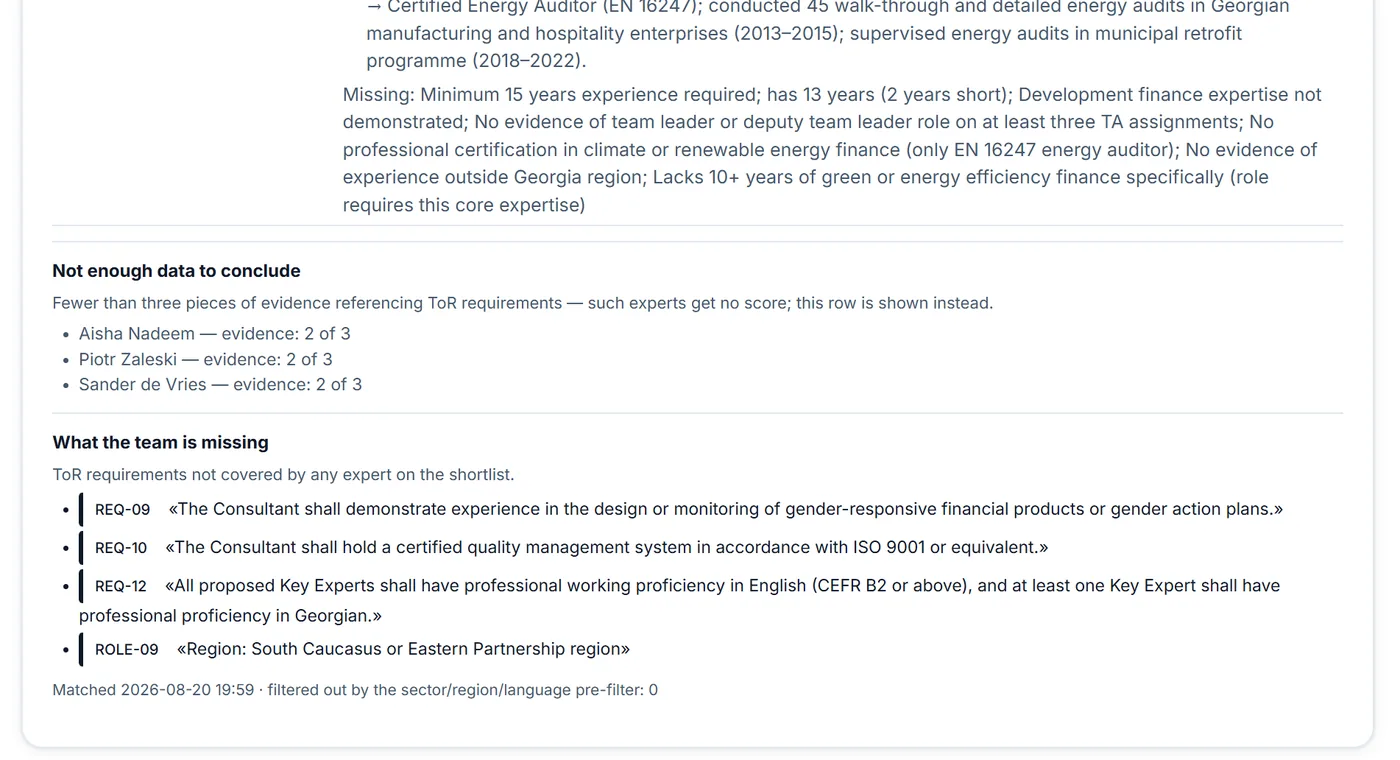
Requirements nobody closes come back as a list — early enough to bring in a partner.
Match the team against ToR roles
Illustrative run100 profiles in the bench · 2 roles selected
| # | Expert | Score | Evidence |
|---|---|---|---|
| 1 | A. Marchetti | 82 | REQ-0714 years · REQ-11French C1 |
| 2 | K. Nowak | 74 | REQ-0711 years · REQ-14PL, RO, BG |
| 3 | S. Halvorsen | 58 | REQ-09MSc Mech. Eng. |
| 4 | D. Ferreira | 31 | REQ-09MSc Env. Eng. — one citation only |
100 profiles · 2 roles · 197 sec — measured on a real run, replayed here in seconds.
Before the first run
How your people get in.
The matching above runs on your own bench, so the fair question is what it takes to have one. Here is the answer, including the parts that are work.
You prepare nothing
CVs go in as the files you already have — PDF or DOCX, in whatever shape they are in. There is no template to fill in first and no spreadsheet to build.
Each file becomes a profile
Employment, projects, languages, certificates, references are read out of the document into fields, and every field stays editable by hand afterwards.
You do not need the whole firm to start
A profile with too little in it is marked incomplete instead of being guessed at. It still competes for roles, and the result names what is missing rather than filling it in. That is the same rule that keeps the empty fields empty further down this page.
It is one person's job, in any order
A file at a time, whenever there is a spare half hour. Uploads are processed one after another, and a second file sent while one is running is told to wait in plain words.
Old .doc files and scanned PDFs with no text layer are refused outright and told why. CV parsing runs against a monthly quota on Monitor; a firm's bench is built on Analyst and above, where there is none. Bulk import from a spreadsheet does not exist — do not plan around it.
Real screenshots, not a mockup
This is what it actually looks like.
The frame at the top of this page is a faithful reconstruction, rebuilt from the product's own stylesheet so it can react to a click. What follows is the real thing.
All four are captures from the running app on a demo account: a fictional consultancy, a fictional donor, a fictional tender.
Measured, not estimated
Every number here came off a real run.
Read end to end into requirements, criteria, deadlines and contract value — timed on a real donor document.
Marked [REQUIRED: …] where the evidence was missing, instead of seventeen invented details.
Verdict borderline, delivered before the week was spent.
100 profiles against 2 roles, start to shortlist — timed on a live run.
Why empty stays empty
The bid you sign is a set of factual claims.
Development banks debar firms over what was written in their own proposals. And the threshold is lower than most people assume: the World Bank's own sanctions law digest counts recklessness — "submission of bids without appropriate review… reliance on representatives without appropriate vetting."
Not intent. Not knowing. Failing to check.
Sanctions cross-recognise between the development banks, and individual experts carry their own. So this tool refuses to be helpful in the one place where helpfulness costs the most.
Requirement text is quoted from your ToR. The model returns which requirement it matched, never wording of its own.
A field your bench cannot answer comes back marked, not filled in.
Below three cited requirements, no score is produced at all.
It reads worse than a page of confident prose. It is also the version you can defend.
Three tiers, no hidden step
What it costs.
Prices and limits match the live pricing page — nothing here promises more than the product does today.
Monitor
€0 free
Entry: should you even bid on this?
- Tenders from legal, open sources
- 1 company profile
- Email alerts on your profile
- 3 ToR analyses with a compliance matrix a month
- Donor CV formats — free while we test this
1 user seat
Start with MonitorAnalyst
€89 per month
Working on a submission
- ToR analysis, no monthly quota
- Scoring with reasoning for every requirement
- Full document package generation (AI-labelled)
- Team matching
1 user seat
Start free, upgrade to AnalystTeam
€590 /mo per firm
Submitting as a team of experts
- Everything in Analyst
- Team matching by role, straight from the ToR
- Role-based document approval, action log, assignment
- Real email invites for team members
Up to 5 seats — the people who run bids
Seats are the people who log in. Experts in your bench are not seats and are not counted: a firm of thirty where five people run the bids fits here. More than five people working inside the system — that is Enterprise, seats unlimited.
Start free, upgrade to TeamEnterprise — on-premise on your own infrastructure, bring your own AI key (BYOK), no limits — by arrangement. Talk to us.
The next step is a conversation
Bring one ToR. We run it with you.
There is no checkout on this page, and at this price that is the point: you get a person, not a payment form. Send the ToR you are weighing right now. We run it in front of you — the compliance matrix against its requirements and, if you send a few CVs with it, the shortlist by role. It costs nothing. What we ask back is your reading of what came out wrong.
Who answers
Denis Tulum, founder. Not a sales desk. No promised response time either — a person writes back, and we would rather say that than invent an SLA.
What we need
The ToR itself, PDF or DOCX. CVs are optional and stay yours.
What happens if you want it
We invoice by email and switch the tier on. There is no card form on this site yet.
No fog
What works today — and what does not.
Bid managers read documents professionally. Anything overstated here gets found on the first call, so nothing is.
Working now
- ToR parsing — requirements, criteria, deadlines, contract value
- Compliance matrix per requirement, with an honest “no data”
- Team matching against ToR roles, with citations and gaps
- Stop signal below the threshold — nothing generated, nothing spent
- Drafts with explicit [REQUIRED: …] holes
- Role-based approval, action log, DOCX and PDF export
- Donor CV formats — 9 MDB-harmonised templates (World Bank TECH-6, EBRD PER-2, ADB TECH-5, KfW and others) plus Europass, live inside a tender and as a standalone download
- 4 donor sources connected today — TED, World Bank, BOAMP, Grants.gov — through 13 connectors, two of them generic (OCDS, RSS). Another 18 are built and switched off: 5 because the source's terms of use forbid reuse, the rest because we have not finished reviewing those terms or the source is not yet worth its quota. We check before collecting rather than after
Not there yet
- Donors with no CV form of their own — EIB, FCDO, Sida, Danida, Norad, Enabel, LuxDev and most bilateral agencies. Inside a tender the CV for them is built from that tender's own ToR, which is how these donors ask for it. What does not exist is a standalone blank to download outside a tender
- Further donor sources are switched on in the order firms ask for them. Until one is live we neither count it here nor promise it
- Your donor is on neither list? Tell us which one and we will say where it stands today — including “not this quarter”, if that is the answer
Before you ask
Questions people actually have.
We have thirty consultants. Do their CVs have to go in before this is useful?
No, and it is not an import project. CVs go in as the PDF or DOCX files you already have, one at a time, and each is read into a structured profile you can then edit by hand. A profile with too little in it is marked incomplete rather than guessed at — it still competes for roles, and the result says what is missing. There is no bulk import from a spreadsheet. Old .doc files and scanned PDFs with no text layer are refused outright and told why.
We are twelve people. Team says five seats — where does that leave us?
On Team. A seat is a person who logs into the system and runs bids; the experts in your bench are not seats and are not counted. If more than five people need to work in the system at once, that is Enterprise, where seats are unlimited.
Where do the tenders and award records come from?
Tender notices and award data come from TED (the EU's official procurement database) and other donor sources, reached through 13 connectors. 4 sources are connected today — TED, World Bank, BOAMP and Grants.gov; another 18 have working connectors but stay switched off. 5 of them because the source's terms of use forbid reuse; the rest because we have not finished reviewing those terms, or because the source is not yet worth its quota. We check before collecting rather than after. Sources beyond these are reviewed and switched on in order of demand; until one is live we neither count it nor promise it. The 2,900,000 award records shown above come from the same TED dataset.
What happens to a CV I upload, and how do I delete it?
Depends where you upload it. Through the free CV tool above, it's reformatted only — never matched or scored against anything. Inside the product, CVs added to your bench are used to score against whichever ToR you run them on. Either way: encrypted in transit (TLS 1.3) and at rest (AES-256), never used to train a model, never sold. Under GDPR you can request access, correction, deletion or export of your data at any time; see the Privacy Policy for how.
Do I need my own Anthropic API key, or do you handle billing?
Either. Bring your own key (BYOK): connect your own Claude API key and pay Anthropic directly — TenderGuru never touches that billing. Or use a TG key: TenderGuru pays Anthropic and you buy TG Coins from us; each scoring or generation action costs a set number of coins.
Does this work for donors outside the EU — World Bank, ADB, EBRD?
Yes — tender discovery, ToR scoring and CV export all work for these donors today. Donor forms aren't interchangeable, so each is templated on its own: World Bank's current form is TECH-6, EBRD's is PER-2 (2023), ADB uses TECH-5 — and the form the industry calls "World Bank Form 1420" is actually USAID's AID 1420-17, a different document from a different donor. Nine MDB-harmonised formats plus Europass are live; donors without their own form (most bilateral agencies) draw the CV structure from that tender's ToR instead.
What doesn't the platform do?
It doesn't submit a bid for you, doesn't guarantee a win, and doesn't invent evidence — every generated document carries visible [REQUIRED: …] gaps until a person fills them in. On Team, documents also go through role-based approval before they are finalised. See "What works today — and what does not" above for the full list.
Can I try it before creating an account?
Yes — but that's the CV tool, not a ToR run. "Try it with a CV" above reformats one CV into a donor's format, free, no signup, no card. Actually running a ToR through the compliance matrix and team matching needs an account: Monitor is free with no time limit — monitoring, alerts, match scoring and 3 ToR analyses with a compliance matrix a month included. Unlimited ToR analysis and document generation start on Analyst at €89/month.